
It's all about play
- Multiple days and locations
- Multiple locations
Learn more about the Wanneroo, Sinagra, Hocking and Pearsall neighbourhoods.
The Wanneroo and Surrounds neighbourhood includes the suburbs of Wanneroo, Sinagra, Hocking and Pearsall. This neighbourhood has grown and changed over time, while still keeping strong links to its past. Wanneroo itself is one of the region’s older, established suburbs, with strong connections to wetlands and rural origins that underpin its identity, while today it functions as a central, well-serviced area with schools and accessible amenities. Sinagra and Hocking represent more recent phases of suburban development, emerging from Wanneroo in the mid-1990s and blending new housing estates with traces of their past, including migrant heritage in Sinagra and remnants of market-garden land in Hocking. Pearsall, while not as well documented, is generally seen as part of this connected group of suburbs. Together, they form an established central area with strong community ties, growing housing development, and an important role as a hub for surrounding neighbourhoods.


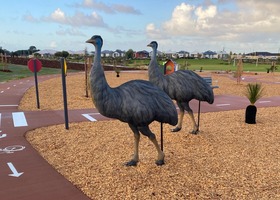
Hocking was named in honour of Herbert Hocking, a wheat and livestock farmer in Wanneroo, and the first Chairman of the Wanneroo Road Board. The suburb name was approved on 1 December 1994.
Pearsall was named after William Charles Pearsall, who, together with his son Charles Frederick, opened the first service station in Wanneroo in 1929 (P09511) and was a member of the Wanneroo Road Board from 1931 to 1950. The suburb name was approved on 1 December 1994.
Sinagra was named after the Italian Sinagra family, who settled in Wanneroo in the 1920s. Vincenzo “Jim” Sinagra arrived in 1923, established a market garden, and later expanded into cattle farming. He also planted olive trees, owned the first olive press in Wanneroo, and produced wine. Jim’s son, Salvatore “Sam,” owned a shop in the area and became a prominent local figure
A wanna is the word for a woman’s digging sticks. ‘Wanneru’ means ‘dance of the digging sticks’. It is not known when Wanneroo came into use in the Swan River Colony, but as early as 1842 a surveyor recorded the ‘road to Wanneroo’ and in 1844, James Dobbins gave his address as Wanneroo. In 1907 the town site was gazetted as ‘Wanneru’. In May 1953 the spelling was officially amended to Wanneroo.
Through the City’s Liveability Survey you told us what your priorities are. Here are your top five priorities, and what the City is doing to address them to create great places.
Stay up to date with the latest news and events in the City of Wanneroo.