
Parking rules help keep roads safe, traffic moving and clear access for pedestrians, residents and emergency services. Find out where and how you can park in the City of Wanneroo, including common restrictions, school parking rules and safety requirements.
Where you must not stop or park
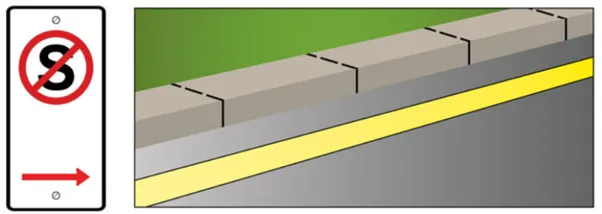
No stopping areas may be indicated by signs or a continuous yellow line painted along the edge of a carriageway. Drivers must not stop on a length of carriageway or in an area where no stopping restrictions apply.
Vehicles may only stop in these areas to comply with other regulations, such as traffic lights or to avoid an accident. Drivers are not permitted to drop off passengers or goods in No Stopping areas.
Drivers must not stop a vehicle within one metre of a fire hydrant or fire plug, or any sign or marking indicating its location, unless attended.
A white ‘H’ road marking indicates the presence of a fire hydrant.
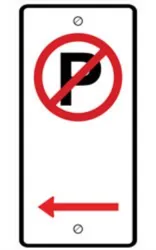
Drivers must not stop in an area where a No Parking sign applies unless all the following apply:
- The driver is dropping off or picking up passengers or goods.
- The vehicle is not left unattended.
- The activity is completed within two minutes after stopping.
Median strips are used to divide traffic flow and improve safety on busy roads.
Vehicles are not permitted to park or stop on any median strip, regardless of whether signs are installed.
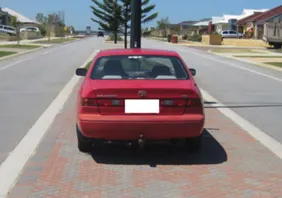
No portion of a parked vehicle is permitted to be on, over or in front of a footpath.
Footpaths provide pedestrians with a safe alternative to walking on roads. When vehicles block any part of a footpath, including the crossover where a driveway meets the footpath, pedestrians may be forced onto the road. This can be frustrating and dangerous, especially for people with prams, people with disability and young children.
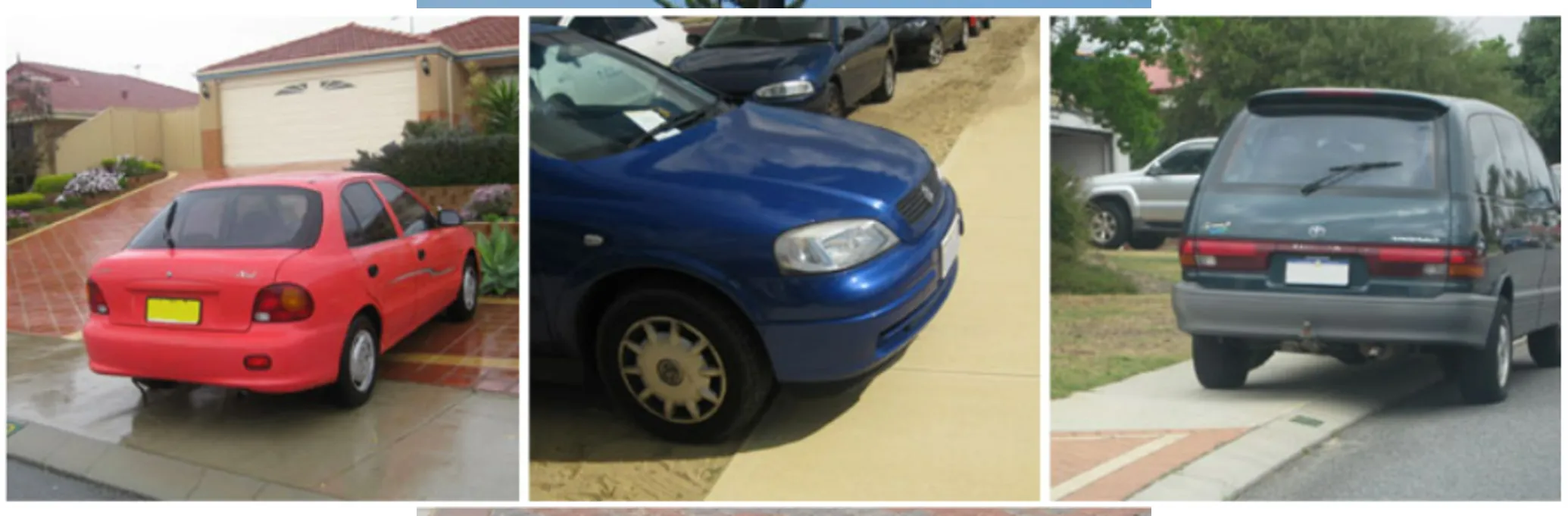
Drivers must not stop a vehicle so that any part of it is between another stopped vehicle and the centre of the carriageway.
Drivers must not stop a vehicle so that any part of the vehicle blocks access to or from a driveway or path.
Parking against the flow of traffic is illegal in Western Australia and can be hazardous, particularly when exiting a parking space.
Vehicles must always be parked or stopped facing the same direction as the flow of traffic.
Parking near bus stops and pedestrian crossings
'Bus' means a motor vehicle, built mainly to carry people, that seats over 12 adults including the driver
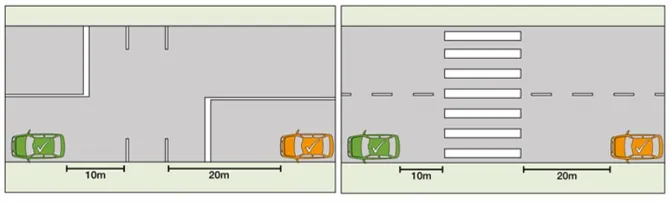
A driver must not stop a vehicle so that any portion of the vehicle is within 20 metres of the approach side, or 10 metres of the departure side of:
A sign inscribed with the words 'Bus Stop' or 'Hail Bus Here' (or with equivalent symbols depicting these purposes) unless the vehicle is a bus stopped to take up or set down passengers; or
A children's crossing or pedestrian crossing.
Drivers must not park a vehicle so that any portion of the vehicle is within 20 metres of the approach side, or within 10 metres of the departure side of a children or pedestrian crossing (this includes school crossings) regardless of whether there are any signs or lines.
Parking near corners or on a carriageway
This area must be kept clear, so other road users have a clear view when approaching and leaving.
Vehicles that are parked too close to a corner pose a danger to other road users negotiating the corner. Trucks and buses need this area to negotiate the turn safely.
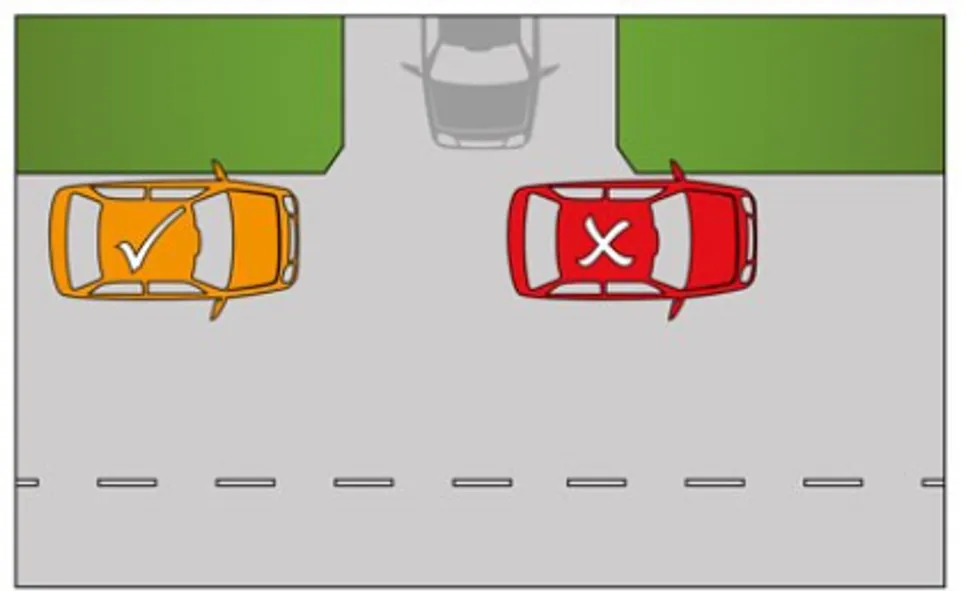
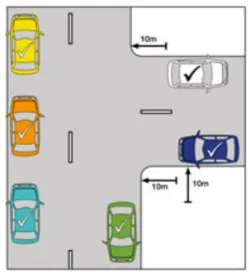
Vehicles may not park within 10 metres of a corner where no traffic lights exist.
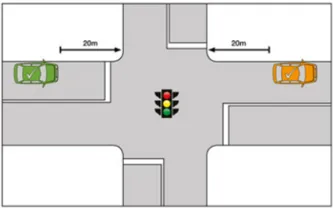
Vehicles may not park within 20 metres from a corner at which traffic lights are installed.
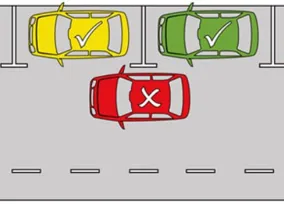
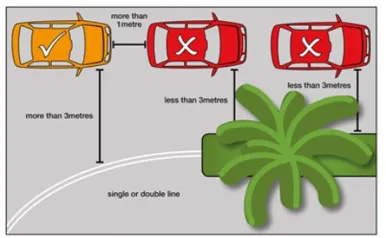
Where a carriageway has a continuous dividing line, dividing strip or median strip, vehicles must be parked at least three metres away unless signage states otherwise.
The parallel parking image shows minimum distance from other vehicles and dividing strip. In this example, the vehicles marked with an 'X' are parked in contravention of legislation.
Parking areas and bays
Vehicles must be parked wholly within marked parking bays.
For parallel bays, vehicles must be parked as close to the kerb as practicable and facing the direction of traffic flow.
If a vehicle is too long or wide to fit in one bay, it must use the minimum number of bays required.
Parking over 24 hours
Parking a vehicle in a public place, including streets, verges and car parks, for more than 24 hours is considered to be causing an obstruction.
Commercial vehicle parking
A commercial vehicle is defined as a motor vehicle constructed or adapted for the conveyance of goods, merchandise or materials used in trade, business, industry or work.
Unless actively picking up or setting down goods, a person must not park on a carriageway for more than one hour a vehicle or combination of vehicles that:
- Is 7.5 metres or more in length, or
- Exceeds a gross vehicle mass (GVM) of 3 tonnes.
Commercial vehicles may park on a verge only if:
- No obstruction is caused to pedestrians or vehicles.
- The vehicle is actively loading or unloading goods to premises adjacent to the verge.
- Any restrictive signage is followed.
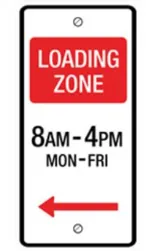
Loading bays are sign posted and marked by yellow lines (either continuous or dashed) and are reserved for commercial vehicles that are engaged in the pickup or setting down of goods.
Commercial vehicles must not remain in that loading zone for longer than a time indicated on the 'loading zone' sign or for longer than 30 minutes if no time is indicated on the 'loading zone' sign.
Private Property Parking Agreement
Use the form below to register your private property and authorise the City of Wanneroo to issue infringement notices under the City of Wanneroo Parking Local Law.
Before starting this form please ensure you have the following documentation at hand to complete this application:
- All land owner's or authorised agents have signed the City's consent document.
- A copy of all pages of the current Certificate of Title.
- Sketch plan (A4 size) indicating, in detail, the location of the area (from which streets the private parking can be accessed from) and the number of bays (indicating the bays that are designated ACROD, Visitors, Clients, Customers or Loading).
- A printout from the Australian Securities and Investment Commission (ASIC) to verify the person executing this agreement is duly authorised to do so by the Landowner(s).
- If one owner, a letter of authority from the Landowner to the Managing Agent, providing authority for the agent to act on their behalf for all matters relating to parking and registration.
- If multiple landowners/strata, a letter of authority from each Landowner to the corporation/authorised agent, (whichever is applicable) to act on their behalf for all purposes relating to parking and registration. For strata titled properties with over ten different owners, provide a copy of the minutes from the most recent meeting resolving to enter into this Agreement and authorising the City to enter the Property.
- Fee of $172 (+ 0.22% surcharge) to be paid at the time of completion.