
The City of Wanneroo is working with the Department of Primary Industries and Regional Development’s (DPIRD) to help manage the spread of the invasive pest Polyphagous shot-hole borer (PSHB).
What does this mean?
The City of Wanneroo currently sits in Zone B of the Quarantine Area. This means City residents:
- cannot move untreated or unseasoned wood outside the Quarantine Area, unless chipped to pieces that are 2.5 cm or less in diameter,
- cannot move plant materials, including living plants, that are greater than 2cm in diameter outside the Quarantine Area,
- can move wood or plant materials, including living plants, into Zone A,
- must ensure any machinery used to handle green waste is cleaned before it can be moved outside the Quarantine Area.
PSHB does not affect grass so lawn clippings can be disposed of as normal.
Check your trees!
We need your help to stop the spread of the PSHB! If you suspect borer damage, report it to DPIRD on 9368 3080, padis@dpird.wa.gov.au, or via the MyPestGuide app.
How to spot infected trees?
- Beetle entry hole – The entrance holes of PSHB are approximately the size of a ballpoint pen tip.
- Discoloration/staining of wood – The fungus cultivated by the beetle can cause dark discolouration on a tree.
- Gumming – Thick sap sometimes pushes the beetle out of the gallery.
- Sugar volcanoes – Crystalline foam may be exuded from entry/exit holes.
- Frass – Produced by the beetle’s tunnelling, frass may present extruding from trees.
- Dieback – In susceptible trees, the fungus kills tree vascular tissue causing branch dieback and tree death.
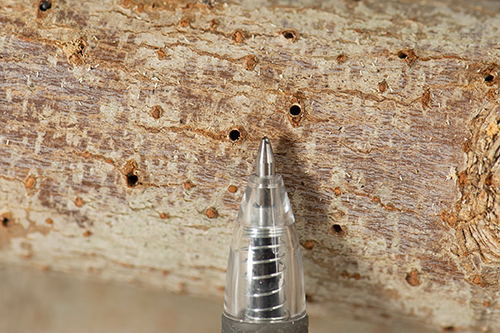
Bore holes |
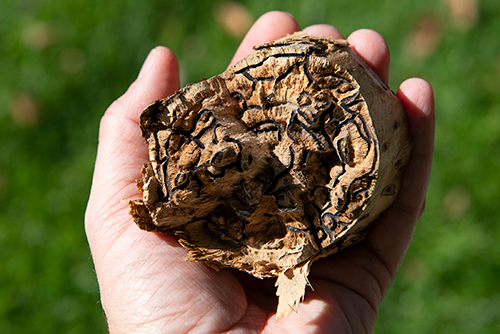
Galleries |
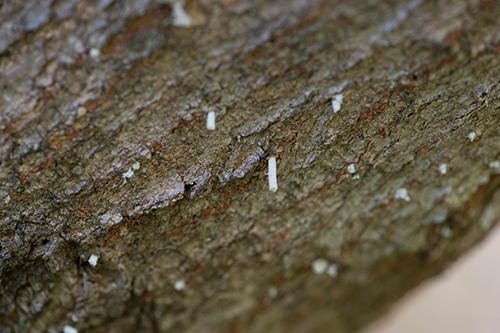
Frass |
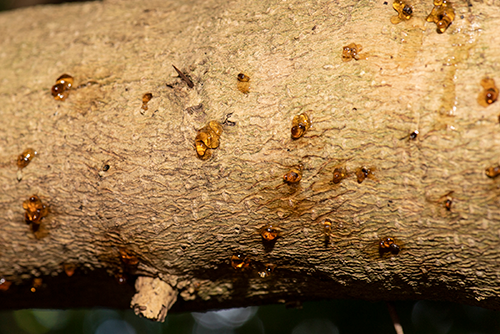
Gumming |
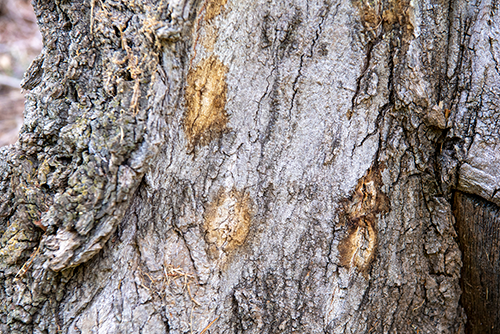
Lesions / staining |
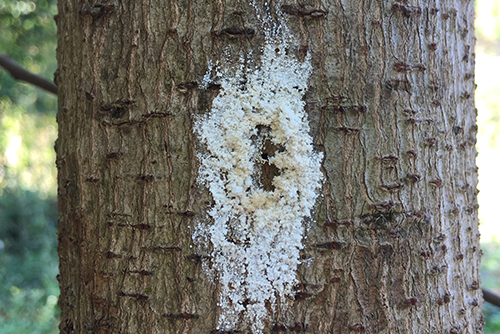
Sugar volcanos |
Top hosts of PSHB include Maple (Acer), Plane (Platanus), Robinia (Robinia), Poplars (Populus), Oak (Quercus), Avocado (Persea), Fig (Ficus) and Coral Tree (Erythrina).
About PSHB
Polyphagous shot-hole borer is a beetle native to Southeast Asia. About the size of a sesame seed, PSHB excavates tunnels in trees where they cultivate fungus as a food source.
This fungus spreads in the tunnels of trees disrupting the flow of water and nutrients. This can result in tree dieback and death.
If PSHB were to become established in the City, it could significantly impact our urban canopy.
DPIRD is undertaking intensive surveillance and management activities across the metropolitan area including:
- surveillance to determine the distribution of PSHB
- containing the pest to prevent further spread to non-infested regions within Western Australia
- removing infested trees to eradicate the beetle and save healthy trees
- providing advice and information to residents, industry and other stakeholders
- ensuring all response activities are conducted safely, consistently and efficiently.
DPIRD have installed surveillance traps throughout the City to monitor the spread of PSHB and have recently detected a positive case in the Wanneroo area.
The City and DPIRD have enacted a Tree Management Plan for the affected tree and will continue to monitor the location closely in the coming weeks.
PSHB is a serious issue across the Perth metropolitan area and a Quarantine Area is currently in place to support DPIRD’s ongoing surveillance and to help to stop the spread of the pest.
In September 2024, the QA was extended to cover the entire Perth Metropolitan area, extending across 30 local government areas including the City of Wanneroo.
The QA encompasses two zones:
- Zone A covers an area with high numbers of infested trees and where intensive control activities such as tree removal are underway.
- Zone B covers an area with fewer or no infested trees, where heightened surveillance is underway to identify and control new infestations, creating a buffer between areas of high infestations and the rest of WA, further protecting WA’s growing areas.
The City of Wanneroo is currently in Zone B.

The City of Wanneroo is collaborating with DPIRD as part of a nationally funded and coordinated emergency response to eradicate the borer from Western Australia.
The City is also training staff to recognise the signs of PSHB activity and raising awareness of the potential impacts of the PSHB within the community.
The best thing you can do to help is to download the MyPestGuide app, inspect your trees, and report any suspected sightings of PSHB.
Let’s work together to eradicate this pest!
More information
Find out more about PSHB at: